

If you told a toy executive 15 years ago that a Chinese collectible brand would be worth more than Hasbro, Mattel and Sanrio combined, they’d probably laugh you out. Yet as of mid-2025, Pop Mart’s valuation stood at roughly US$44.43 billion, surpassing the old-school giants of the global toy industry.
The secret isn’t plastic. It’s feelings.
Gen Z and the Rise of Emotional Value
And now, increasingly, Gen Z consumers are shopping for emotional return on investment (including some GenX and Y, ahem...). Blind box toys, where buyers don’t know which character they’ll get, perfectly tap into this mindset. The thrill of uncertainty, the dopamine hit of surprise, and the comfort of collecting, all play into a deeper desire, emotional regulation.
Characters like Labubu, Molly, Skullpanda, and Crybaby aren’t just toys. They’re mood avatars. One Skullpanda for a melancholic day. A Crybaby is clipped onto a bag when life feels overwhelming. A Labubu guarding your phone like a mischievous emotional support gremlin. These figurines travel with their owners as accessories, tiny reflections of inner states.
Then the blind box concept hasn’t stayed in toys. It’s quietly resurfaced in entertainment—especially music. Buying albums with randomised celebrity photo cards, forcing fans to purchase multiple copies to get the idol they want, feels curiously like the 1990s all over again: same psychology, new packaging.
Buying something with “little practical value” suddenly makes perfect sense when it contributes heavily to emotional well-being.
But emotional economies are fragile. By December 2025, Pop Mart’s stock had slid nearly 44% in just four months, wiping out over US$25 billion in market value. One primary concern: overexposure. Analysts warned that aggressive production, especially of Labubu, could destroy the scarcity that made the brand desirable in the first place.
When everyone has the same emotional anchor, it stops feeling special.
What’s the next emotional investment after blind boxes?
Enter CES 2026, the Consumer Electronics Show — the world’s biggest stage for consumer technology. This year, one signal became impossible to ignore: physical IP is converging with AI companionship. It’s not so much about the clunky, humanoid robots anymore but shift toward something far cuter — a plushie that interacts with you and… talks to you (yes, slightly Chunky vibes).
Ropet by Mengyou Intelligence first appeared at CES 2025. Pre-sold in JD.com China, and covered by Forbes, BBC, and CNBC, it is emotionally responsive. Then, more in CES 2026, the floodgates opened.
Leimeng Technology’s Bibo looks like an electronic cousin of Labubu. It recognises faces, tone, and movement, reads emotional states, and proactively interacts using emotional AI.
Lovipeer by LOVEAXI goes deeper, combining micro-expression recognition, NLP, adaptive learning, and bilingual conversation. It can comfort you when you’re sad, and tutor your child in English when you’re not.
Honghuo Moya, wrapped in plush fur, focuses on sleep and “active embodied empathy,” offering emotional support alongside practical assistant functions.
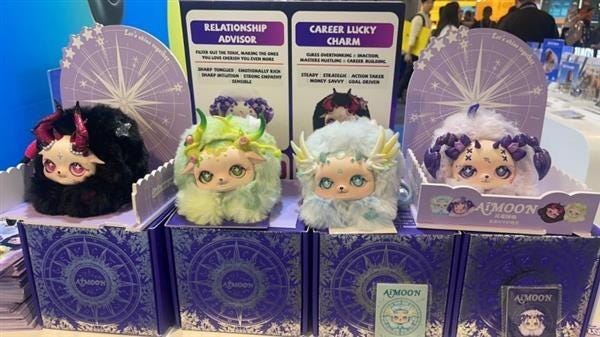
AiMOON by Lynxaura Intelligence (灵犀智能), which looks similar to skullpanda, is powered by zodiac culture and emotional memory systems. It tracks moods, remembers preferences, and shifts personality accordingly: therapist, hype partner, or professional complainer.
Even legacy giants are paying attention. Panasonic’s NICOBO responds to touch, recognises faces and voices, and exists purely to make homes feel less lonely.
Where This Leaves Us
Surprise boxes were never really about toys. They were about outsourcing emotion, letting objects carry feelings we didn’t know how to process ourselves. AI companions take this idea one step further. Instead of silent figurines, we now have responsive, learning, emotionally aware entities.
In the future, every household will likely own one or two companion robots. Not as gadgets, but as emotional infrastructure, perhaps, digital extensions of the human.
But one thing is clear, the next wave of consumer tech won’t just solve problems. It will feel something while doing it, and maybe think with us. Cute or creepy? We’ll find out soon, won’t we.