

AI capabilities are advancing rapidly across diagnostics, workflows, and patient care, yet much of healthcare still operates on fragmented systems, outdated infrastructure, and reactive models of care.
Most healthcare systems today were built to respond to illness after it occurs, while AI is increasingly shifting conversations in healthcare toward more preventive, personalised, and outcome-oriented approaches to care. But meaningful adoption may require more than simply layering AI tools onto existing systems.
This growing disconnect between technological advancement and healthcare system readiness formed the core of the discussion during the panel session
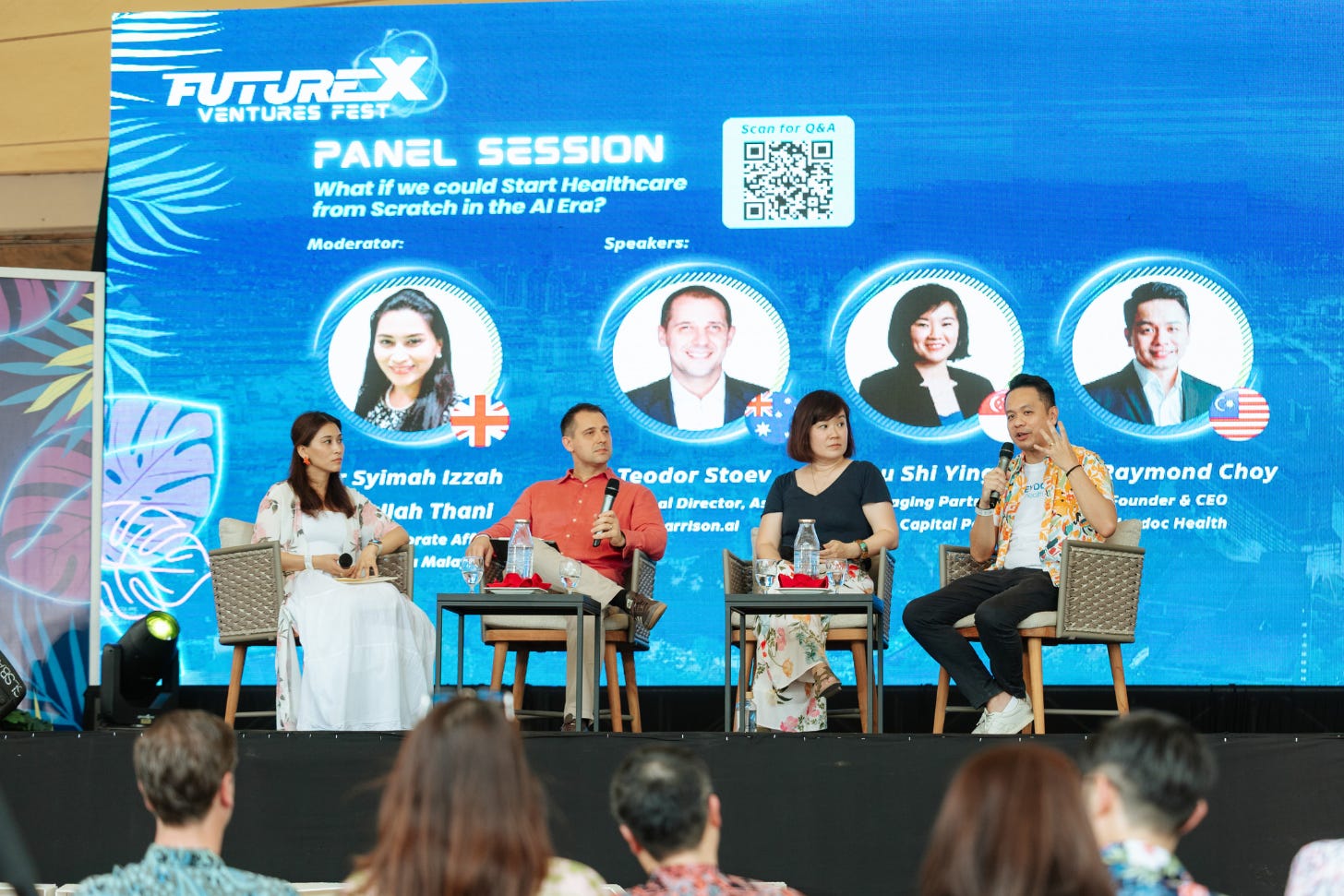
“What if We Could Start Healthcare from Scratch in the AI Era?” at
FutureX Ventures Fest 2026, organised by Sunway iLabs on 12 May 2026.
Moderated by Nur Syimah Izzah Abdullah Thani, Head of Corporate Affairs at AstraZeneca Malaysia, the session brought together perspectives from healthcare AI, venture capital, and digital health to explore how healthcare systems may need to evolve alongside the rapid pace of AI development.
Panel Speakers:
Teodor Stoev
Regional Director, Asia, Harrison.aiLau Shi Ying
Managing Partner, Adaptive Capital PartnersDr. Raymond Choy
Founder & CEO, Heydoc Health
When Technology Moves Faster Than Healthcare Systems
Healthcare is often trying to integrate AI into systems that were never originally designed for it.
Despite rapid advances in diagnostics and workflow automation, many healthcare providers still rely heavily on disconnected operational processes, siloed data systems, and workflows built years ago.
One of the panelists compared this challenge to building advanced highways on top of broken roads, where the limiting factor is no longer the technology itself, but the surrounding infrastructure and the way healthcare delivery is currently organised.
This extends beyond hospitals and into the patient experience itself.
Many patients still navigate healthcare through fragmented pathways, relying on referrals, assumptions, or trial and error to determine where to seek treatment.
AI could eventually support more connected and coordinated care pathways, like a “Waze for healthcare,” helping guide patients toward appropriate care based on symptoms, medical history, and healthcare outcomes.
Building the Foundations for Scalable AI
As the conversation shifted toward what would be needed to support AI adoption, two key areas were repeatedly highlighted: the importance of better-connected healthcare systems and the need to make future healthcare models more accessible and scalable.
Connected Healthcare Systems and Shared Data
Since data across the healthcare ecosystem remains deeply fragmented, patient records often do not move seamlessly across providers, limiting the ability of AI systems to learn from complete patient journeys and long-term patient data.
Without interoperable infrastructure and shared data standards, the ability for AI systems to scale meaningfully across healthcare environments remains limited.
Countries such as Indonesia and the UK were highlighted as examples of how governments are approaching this challenge. Indonesia’s SATUSEHAT initiative was highlighted for its efforts to integrate healthcare records across providers through shared standards, while the UK’s NHS has invested heavily in genomic profiling and polygenic risk scoring to support more preventive and precision-based approaches to healthcare.
These reflect a growing recognition that healthcare systems need to exchange data more seamlessly for AI technologies to be adopted meaningfully at scale.
Making AI-enabled Healthcare Accessible
The speakers also discussed how more affordable and accessible healthcare models could help widen participation while generating the real-world data needed to improve future AI-driven healthcare systems.
Healthcare costs continue to rise globally, with healthcare expenditure estimated at approximately US$10 trillion annually, while a substantial portion of healthcare resources may still be lost to inefficiencies, fragmented systems, and gaps in care coordination.
Against that backdrop, the panel explored whether healthcare could eventually move toward more accessible subscription-style models, similar to how platforms such as Netflix popularised continuous access through simple, low-barrier recurring pricing models.
The idea was not necessarily about replicating streaming platforms themselves, but about creating healthcare systems that encourage more consistent participation rather than patients only engaging with the system when serious illness occurs.
Broader participation could generate richer real-world healthcare data over time, potentially supporting more personalised care pathways and improving the scalability of future AI-driven healthcare tools.
Trust, Adoption and the Human Factor
Yet even with stronger infrastructure and scalable systems, adoption ultimately depends on people as much as technology.
Healthcare remains an industry built heavily on trust, expertise, and established workflows.
As AI systems become more capable, adoption will depend not only on technological performance, but also on whether healthcare professionals feel confident integrating these tools into clinical practice.
The importance of measurable outcomes, clinical validation, and careful integration into existing healthcare environments was repeatedly emphasised as key factors in building trust and encouraging adoption across healthcare settings. Without it, even highly capable technologies may struggle to achieve widespread adoption.
Ultimately, this painted a picture of a healthcare industry navigating a period of significant transition.
Because in the AI era, healthcare transformation is becoming as much a systems challenge as it is a technology one, requiring not only new tools and infrastructure, but also a willingness to remain open to change.
Acknowledgements
Special thanks to Teodor Stoev, Regional Director, Asia at Harrison.ai; Lau Shi Ying, Managing Partner at Adaptive Capital Partners; Dr. Raymond Choy, Founder & CEO of Heydoc Health; and Nur Syimah Izzah Abdullah Thani, Head of Corporate Affairs at AstraZeneca Malaysia, for their thoughtful insights and contributions during the panel session at FutureX Ventures Fest 2026.