

Previously, we explored service robotics from the outside in: the different ways robots are starting to show up in the real world. The focus was on what robots do and where they might realistically fit into daily operations.
But look at what just happened during the humanoid robot showcase at China’s state broadcaster, CCTV’s Spring Festival Gala. Chinese firm Unitree Robotics stunned audiences with fluid movements, agility, and impressive martial arts performance on stage alongside young human artists during a live national broadcast.
A stark contrast to the stiff dance routines we saw just a year ago in 2025, this performance signals how quickly humanoid capabilities are evolving.
Now, we shift the lens. As we move through 2026, the industry is no longer just fighting over how robots move; it’s fighting over how they think.
The Brain and the Body
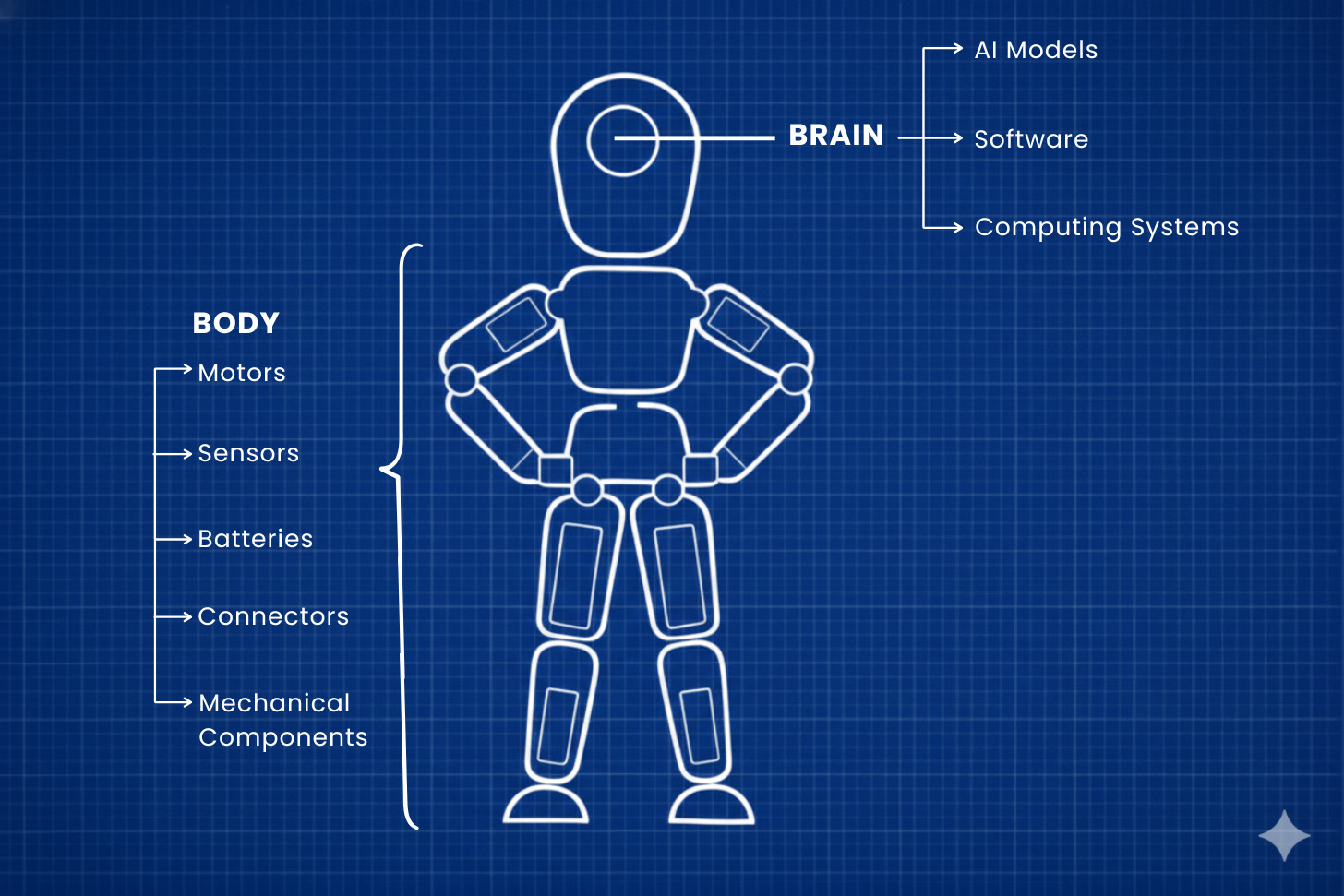
At a basic level, many modern robots can be understood through two parts: a brain and a body.
The brain is the thinking part. It’s what lets a robot see the world, make decisions, and plan its next move. It’s made up of the AI models, software, and computing systems that turns data from sensors into action.
The body is the doing part. It’s the motors, sensors, batteries, connectors and mechanical components that enable movement, balance and interaction with the real world.
This distinction shows that not all robotics companies build the same thing. Some focus entirely on the brain, while others build full-stack systems, tightly integrating the brain with the body to deliver complete robots.
Selling the Universe Mind - The “Android” Play:
If the last decade was about mechanical engineering, 2026 is about Foundational Intelligence. A growing faction of the industry argues that the physical hardware is a solved problem; the real bottleneck is the “ghost” in the machine — the intelligence.
Brain Providers are the Google of this new era. They don’t want to build the metal, they want to build the Operating System that runs on everyone else’s hardware. That’s where some companies are placing their bets.
Companies like Skild AI and Physical Intelligence are building foundational models for the physical world. Their goal? A universal “robot brain” that can be dropped into a forklift, a humanoid, or a robotic arm and just work.
Others, such as PrismaX, work on the data and learning layer that helps robots improve through real-world use. Even firms like HappyRobot AI show how powerful software systems can automate complex work without being tied to a specific machine.
It’s similar to how NVIDIA powered the AI boom. Companies like OpenAI, Anthropic, and Meta, run their large language models (LLMs) on NVIDIA chips. Different applications, same underlying layer. Brain providers in robotics are aiming to become that shared intelligence layer, powering many different machines.
The Full-Stack Titans: The “iPhone” of Robotics
While the brain camp bets on a universal OS, the full-stack builders are playing a different game entirely. They aren’t just writing the software, they are forging the steel. This is the Apple model of robotics: a closed-loop system where the “Mind” and the “Machine” are designed as a single, inseparable unit.
Some companies choose to design and build both brain and body together, tightly integrating AI with hardware from the start. These full-stack builders control the entire system, from the motors and mechanics to the software that drives them.
Companies like Figure AI, Apptronik, UBTECH, Unitree, LimX Dynamics, and Fourier Intelligence fall into this category. They design robots where intelligence and physical design evolve side by side. The primary advantage of this approach is total optimisation:
Lightning-Fast Reflexes: In the physical world, a split-second delay is the difference between a robot catching a falling object or causing an expensive accident. By building both the sensors and the software, these companies achieve a level of precision that universal brains can’t match.
Physical Intuition: These builders argue that true intelligence must be “embodied.” This means the AI isn’t just a generic program, it intimately understands the unique physics and “muscles” of its own custom-built body.
When the same company builds both the body and the brain, it can optimise performance, balance, and behaviour as one cohesive system rather than stitching mismatched components together. If brain providers aim to create reusable intelligence platforms, full-stack builders aim to deliver complete, turnkey machines ready to operate in the real world.
The Missing Middle: The Data Pipeline
In 2026, the real bottleneck isn’t the “Brain” or the “Body”, it’s the data pipeline connecting them. Without Robot Operations (RobOps), even the most advanced machine is just an expensive paperweight.
Data is the new oil, and the industry is drilling for it in two ways:
Synthetic Data: To bypass the slow, costly process of real-world training, companies use hyper-realistic simulations. Here, robots practice tasks millions of times in seconds before touching a factory floor.
Data Sovereignty: As robots enter homes and hospitals, privacy is paramount. Firms like PrismaX are leading the charge in ensuring that the sensitive data robots collect remains secure and private.
While Silicon Valley perfects the “Mind,” China is building the infrastructure to feed it. By leveraging its massive manufacturing footprint and deploying “cyber-labourers”, human operators in VR rigs who act out tasks for AI to learn, China has become the world’s largest sandbox for RobOps.
Robotics: Ready or Not?
Big players in the industry suggest that robotics is approaching a breakthrough, though more cautious voices point to the constraints.
At CES 2026, NVIDIA’s Jensen Huang said the “ChatGPT moment for robotics is nearly here,” signalling that advances in AI could soon unlock a step change in robotics capability.
Yet Morgan Stanley’s 2026 report offers a grounded reminder, that robots today remain costly. Wider adoption will depend on hardware becoming cheaper, systems becoming more reliable, and AI models improving enough to operate consistently beyond controlled settings.
Where This Leaves Us
The robotics industry is currently in its “dial-up” phase; it is functional but waiting for its broadband moment. Whether the winner is a universal “Android-style” Brain or a specialised “Apple-style” Full-Stack machine, the prize is the same: the automation of physical labour.
Acknowledgements: Thank you to the Sunway iLabs team for their invaluable contribution and insights in preparing this article.
References
FutureX Insights. (2026). Robots Among Us. Futurexinsights.news. https://www.futurexinsights.news/p/robots-among-us?r=6i8ih6&utm_campaign=post&utm_medium=web
Morgan Stanley. (2026, January 26). Embodied AI and the Rise of Humanoid Robots. Morgan Stanley. https://www.morganstanley.com/
The Star Online. (2026). China’s humanoid robot makers pivot from “body” to “brain” as commercial race heats up. The Star. https://www.thestar.com.my/aseanplus/aseanplus-news/2026/02/07/chinas-humanoid-robot-makers-pivot-from-body-to-brain-as-commercial-race-heats-up