

Could one person really build and run a company with AI? A few years ago, that would have sounded like a Silicon Valley fever dream. The kind of line you put in a keynote because it makes people look up from their phones.
It sounds a bit like Peter Parker (Spider-Man) trying to juggle work, save New York, make ends meet, and pay rent all by himself after everyone forgot who he was. Except now, AI can actually help you pull it off.
In 2024, OpenAI CEO Sam Altman predicted that we could eventually see the world’s first one-person billion-dollar company. Not long after, NVIDIA CEO Jensen Huang described a future where companies manage both human and digital employees.
Different predictions, same direction: the number of people needed to start, operate and scale a business may be shrinking.
And that changes the psychology of entrepreneurship.
For the longest time, starting a company came with an invisible checklist. Find a co-founder. Raise money. Hire people. Build a team. Then, maybe, start selling.
AI is starting to scramble that order. That is the idea behind the one-person company, or OPC.
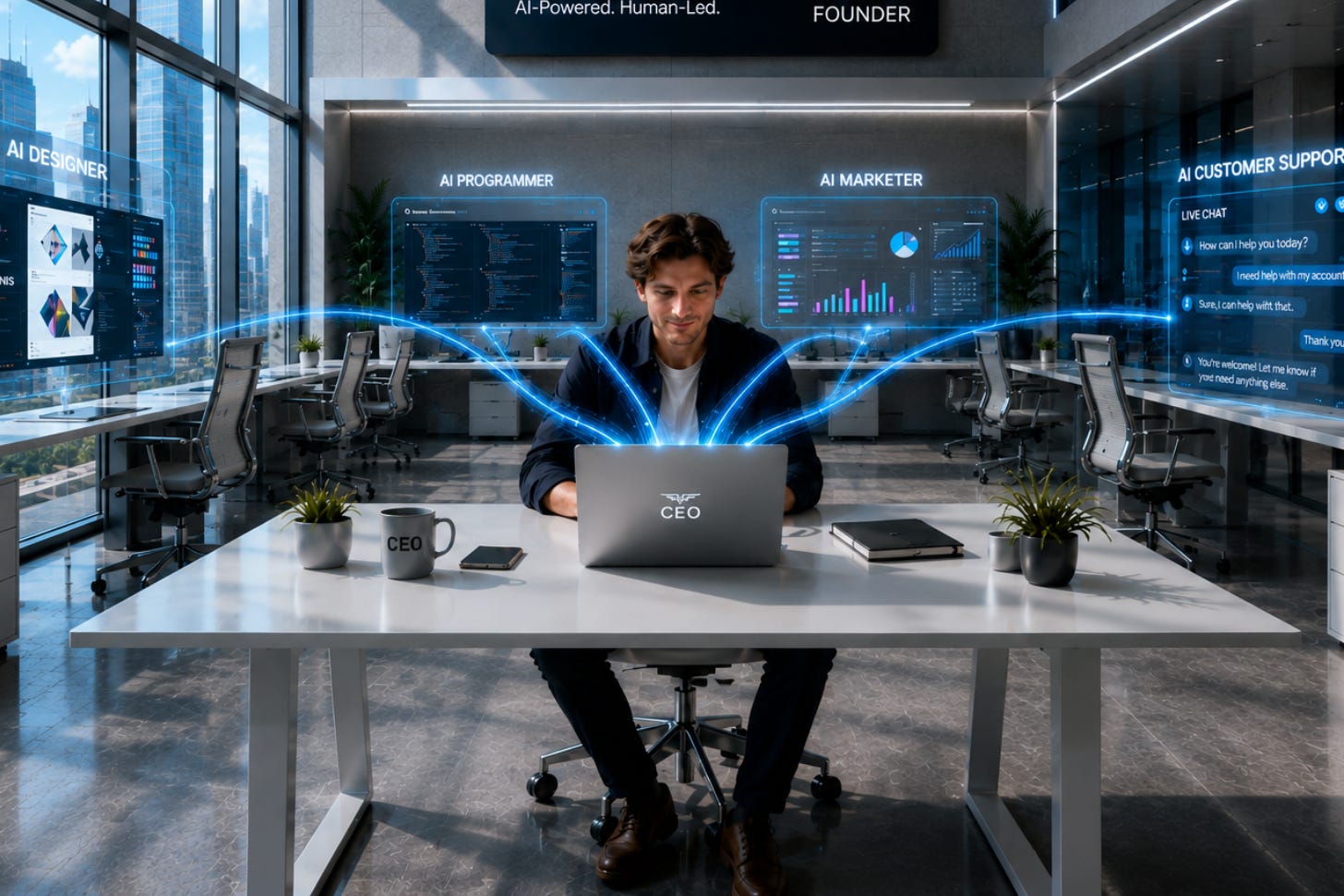
Then came the digital worker
Last March, the idea became easier to picture. Almost overnight, everyone seemed to be talking about trying to “raise a lobster.” OpenClaw, an open-source AI agent that could act across apps, files and online workflows, gave many people their first real glimpse of what a digital worker might look like.
Not a chatbot waiting for prompts. Not a fancy search bar. Something closer to an employee who never sleeps.
Recently, Tim Tiah, a Malaysian influencer, shared that his media business made RM1.7 million in three months with zero full-time staff.
Zero full-time staff.
Not zero help. Not zero people involved. But a business built around AI agents, freelancers and specialists instead of a traditional full-time team.
That is what makes the idea feel real now.
It is no longer just “Can one person build a billion-dollar company?”
Maybe the better question is: if the tools are already available, what is stopping more people from testing the idea for themselves?
The solo business just got an upgrade
In a way, OPCs have always existed.
We just used to call them freelancers, consultants, solo founders, creators, designers, developers, coaches or contractors.
People have been building businesses around one person’s skills for a long time.
The difference is that those businesses usually hit a ceiling quickly. There are only so many clients one person can serve, emails one person can answer, and proposals, invoices or reports one person can manage before the business becomes trapped by their time.
That is where AI changes the equation.
It does not remove the founder. It gives the founder something closer to a sidekick.
A solo operator can now prototype faster, write faster, research faster, automate repetitive work and manage more moving parts without immediately hiring a team. The boring but necessary parts of running a business no longer need to sit entirely on one person’s shoulders.
Sometimes, the reason people do not start is not because they lack ideas. It is because the operational weight feels too heavy before they even begin.
AI lowers that weight.
The idea is starting to look less far-fetched
In the United States, Nasdaq Economic Institute reported that more people are formally setting up one-person businesses, with applications rising by more than 20% from early 2025, partly linked to AI lowering the barriers to starting and operating a business.
China shows a similar direction at a much larger scale. By mid-2025, the country had more than 16 million registered one-person limited liability companies. The trend has attracted attention from regional policies, community hubs and even some commercial banks exploring how to support AI-powered OPCs.
And solo does not necessarily mean small anymore. Since 2023, the number of solo founders generating more than US$1 million annually has more than doubled, while those exceeding US$5 million and US$10 million have grown even faster.
So yes, the OPC concept still sounds ambitious. But it is no longer ridiculous.
Starting an OPC may be getting easier. Building one that people trust, pay for, and keep coming back to? That is still the boss fight.
Starting is not the same as surviving
AI can make starting easier. It cannot manufacture demand, trust or defensibility.
One early estimate suggests that only around 20% of AI-powered OPCs have managed to turn their initial momentum into a business that can sustain itself.
In other words, launching may be getting easier. Getting customers to stay, and keep paying, is still the harder part.
That is also where the moat question comes in.
If your entire business is built on tools everyone else can access,
what makes you hard to copy?If your workflow can be replicated in a weekend, where is the defensibility?
The best OPCs probably will not win because they are the most automated.
They will win because they combine automation with something harder to replicate: taste, judgment, relationships, distribution, domain knowledge or trust.
You can launch a product in a week. You can write content in minutes. You can automate follow-ups before lunch. But if nobody cares, all you have built is a very efficient empty shop.
The more AI takes on execution, the more valuable human judgment becomes.
Speed still needs judgment
That is why the Medvi story matters.
On paper, it looked like the OPC dream. A telehealth startup with just two employees reportedly generated US$401 million in revenue in its first full year, with projections reaching US$1.8 billion for 2026.
But the story quickly became messier. Reports raised concerns around AI-generated doctor personas, aggressive affiliate marketing and questionable health ads.
Medvi is not a clean example of AI replacing manual labour. It is a reminder that speed without governance can create its own problems.
Or, to borrow the famous Spider-Man line: “With great power comes great responsibility.”
So the point is not that AI can help more people test ideas, build businesses and operate at a level that used to require a team. But the founder still has to decide what is worth building, what is ethical, what is sustainable and what customers will actually value.
So, where does that leave us?
The OPC is becoming more possible because AI removes some of the operational drag that used to weigh a person down.
It can help one person handle more moving parts than before, but it still cannot decide what is worth building. It cannot create trust out of thin air, or make customers care.
That part is still on us.
You do not need to quit your job tomorrow. You may not need a seed round. You can start smaller.
It is still early, messy and probably overhyped in some corners. But that is what makes it interesting.
So take the shot.
Let AI handle more of the execution.
The first one-person unicorn might still be up for grabs.
Acknowledgements: Thank you to the Sunway iLabs team for their invaluable contribution and insights in preparing this article.
References
Moomoo Technologies Inc. (n.d.). Artificial intelligence is fueling a surge in OPC‐related startups—How should commercial banks enter the fray? While some banks are experimenting and taking early steps, major institutions tend to adopt a wait-and-see approach. Moomoo Technologies Inc.
Confino, P. (2024, February 6). Could AI create a one-person unicorn? Sam Altman thinks so—and Silicon Valley sees the technology “waiting for us” | Fortune. Fortune.
Gownder, J. (2026, April 8). Beware the magical Two-Person, $1 billion AI-Driven startup. Forrester.
Griffith, E. (2026, April 10). How AI helped 1 man (and his brother) build a US$1.8 billion company. The Star.
Normyle, M. (2026). AI is enabling more entrepreneurship. Nasdaq.
Tedeschi, E., Rama, M., & Cruickshank, C. (2026, June 22). The age of the solopreneur. Stripe Economics.