

Legal work has always depended on human judgment and accountability. As research went digital, legal practice evolved. Today, AI-powered legal tech is driving the next shift: handling high-volume, repetitive work with speed and consistency, while freeing legal teams to focus on deeper analysis, strategic client engagement, and critical judgement.
For corporates, this allows for efficiency, reducing turnaround time, and making better use of legal expertise across the organisation.

What Is Legal Tech?
Legal tech refers to software and AI-based systems designed to help legal professionals work more efficiently by handling routine tasks such as research, drafting, contract review, due diligence, compliance checks, and post-execution management, while humans remain in control of all legal decisions.
How Legal Tech Adds Professional Value in a Corporate Setting
For corporates, the value of legal tech lies in its ability to support legal teams handle large and complex workloads with consistency. AI-enabled tools can review contracts and legal materials at scale, applying the same standards set by legal teams across documents, which can be useful for companies dealing with recurring agreements, regulations, or operations.
Legal tech saves time by taking on repetitive, low-value tasks that requires days or even weeks, such as initial contract reviews or information extraction. This frees internal legal teams and external legal advisors to focus more on important work such as analysis, risk assessment, negotiation, and strategic advice that directly support business decision-making.
Just as importantly, some legal tech tools are designed to spot potential risks areas by flagging unusual clauses, key obligations, or deviations from standard terms. When used appropriately, this can support quality control and help reduce the likelihood of issues being overlooked due to workload volume.
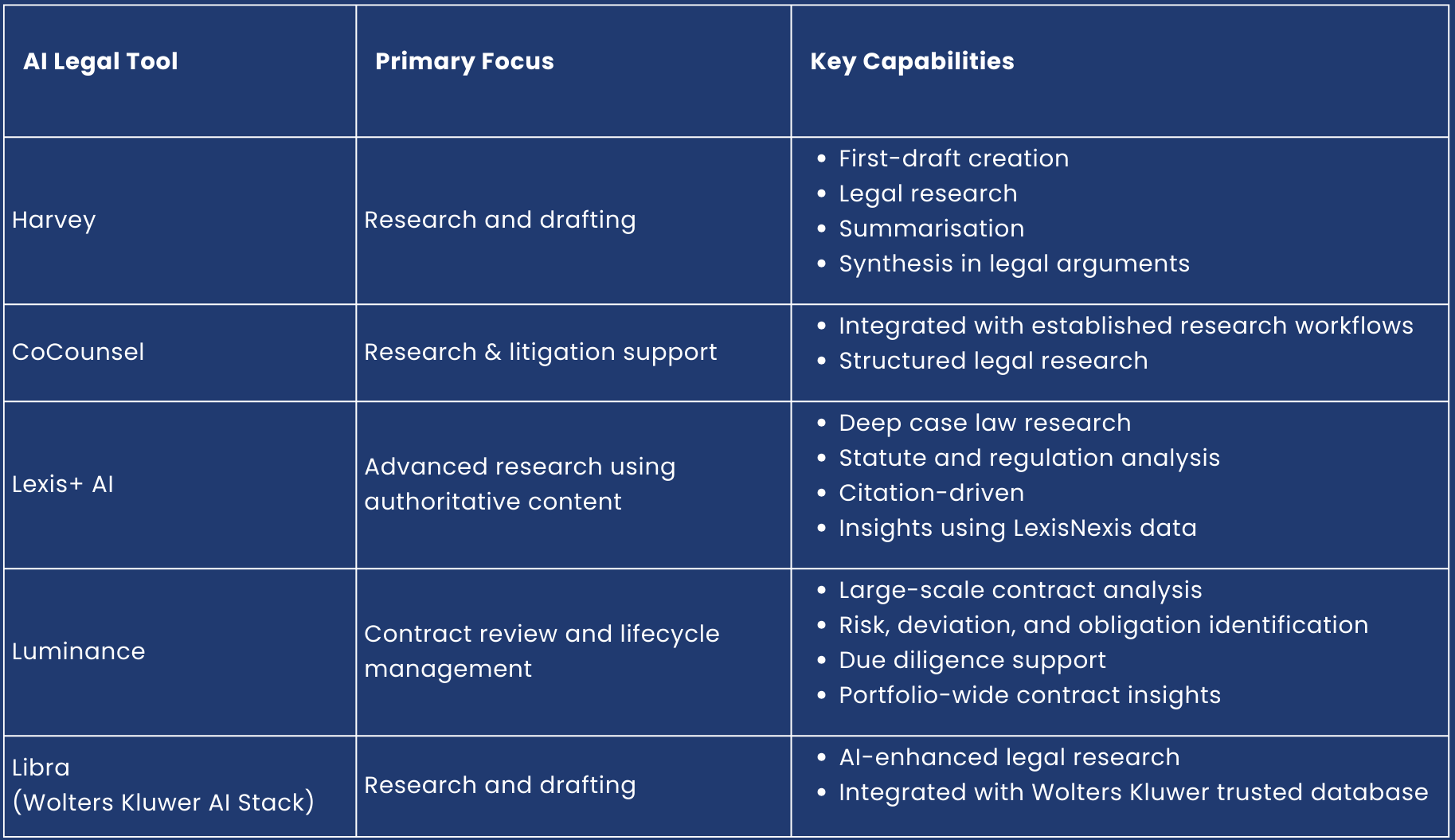
Key Legal Tech Tools and Their Roles
Choosing the Right Legal Tech
For corporates, adopting legal tech works best when it starts with everyday realities rather than technology itself. A helpful first step: Identify where legal processes most often slow the business down, whether that is waiting for contract reviews, multiple drafting iterations, or time spent clarifying legal positions.
Matching Tools in Practice
Different legal AI tools are designed for various types of legal work. Solutions such as Harvey, CoCounsel, or Lexis+ AI can help legal teams and external legal advisors work more efficiently on research and drafting.
At the same time, platforms like Luminance or Libra are better suited for handling high volumes of contracts and compliance-related reviews, such as tenancy agreement, MOUs, Non-Disclosure Agreement (NDA), as well as contract comparison, particularly when benchmarking documents against a consistent standard set by the legal team.
Most importantly, successful adoption respects how legal teams work. Tools that fit naturally into familiar environments, such as Microsoft Word or existing document systems, are far more likely to be used effectively.
A Real-World Perspective
That shift is already visible in practice. A Fortune article published in May 2025 highlights how AI-powered legal tools such as Harvey are taking on routine, time-insensitive tasks, allowing junior lawyers to engage earlier in more analytical and problem-solving work.
More broadly, this reflects how AI can change the balance of work within teams, creating more exposure to practical, real-world experience, while routine tasks are handled more efficiently in the background.
Major Industry Signals: AI Investment and Strategic Acquisitions
Harvey’s $8 Billion Valuation Backed by Andreessen Horowitz
Andreessen Horowitz (a16z) a venture capital firm behind Airbnb, Facebook, Figma, and GitHub, has taken major step into legal tech by leading a $150 million funding round into Harvey, valuing the company at around $8 billion (Bloomberg, 2025). This investment suggests growing market validation that AI for legal workflows is becoming core infrastructure for modern legal practice.
Wolters Kluwer Acquires Libra, Strengthening Integrated AI for Legal
Another significant development came from Wolters Kluwer’s — a European-based professional information and software company — acquisition of Libra Technology GmbH for up to approximately €90 million (RTTNews, 2025). The move integrates Libra’s AI legal assistant capabilities with Wolters Kluwer’s extensive legal content and tools, aiming to deliver a unified platform for legal research, drafting, and analysis built to support lawyer workflows.
Together, these developments show that legal tech is not a trend, but an evolving ecosystem shaped by market demand and professional standards.
Legal Tech Is an Enabler, Not a Replacement
Legal tech does not diminish the role of lawyers, it amplifies professional expertise. These tools help legal professionals focus on what humans do best; judgment, interpretation, strategy, and client care.
The latest investments and acquisitions, from Harvey’s billion-dollar valuation boost to Wolters Kluwer’s integration of Libra, reflect confidence that legal tech will partner with legal professionals to elevate practice standards, not undercut them.
Legal tech is not a shortcut. It is a strategic ally that strengthens how legal work is done, how insights are generated, and how clients are served.
Disclaimer: This article is for general information only and does not constitute legal advice.References
Clark, K. (2025). Andreessen Horowitz Invests in Legal AI Startup Harvey at an $8 Billion Valuation. Bloomberg. https://www.bloomberg.com/news/articles/2025-10-29/andreessen-horowitz-invests-in-legal-ai-startup-harvey-at-an-8-billion-valuation
Mollman, S. (2025). An AI tool has become so useful to junior lawyers at PwC that “there’d be a riot” if the firm took it away, says partner. Fortune. https://fortune.com/2025/05/09/ai-legal-tool-harvey-junior-lawyers-careers/
RTTNews. (2025). Wolters Kluwer To Acquire Libra Technology For Up To EUR 90 Mln. Nasdaq.com. https://www.nasdaq.com/articles/wolters-kluwer-acquire-libra-technology-eur-90-mln