

Previously, we explored robotics from two different angles. First, we looked at how robots are already showing up in everyday operations, from cleaning toilets to parking cars. Then we zoomed in on how robots are built: the “brain” that powers their intelligence, and the “body” that carries out physical work.
Our team at Sunway iLabs has been closely following the evolving robotics landscape. Signals are becoming clearer: robots are steadily moving beyond research labs and controlled demonstrations into real operational environments. Even industry leaders like NVIDIA CEO Jensen Huang has suggested that robots could be only a few years away from widespread use.
As more robotics companies enter the field and promise similar capabilities, how do we determine which robot actually makes sense for a given use case? The situation is not unlike the early days of smartphones, when dozens of devices appeared with seemingly similar features. The real question then becomes:
What should we really look for when evaluating a robot?
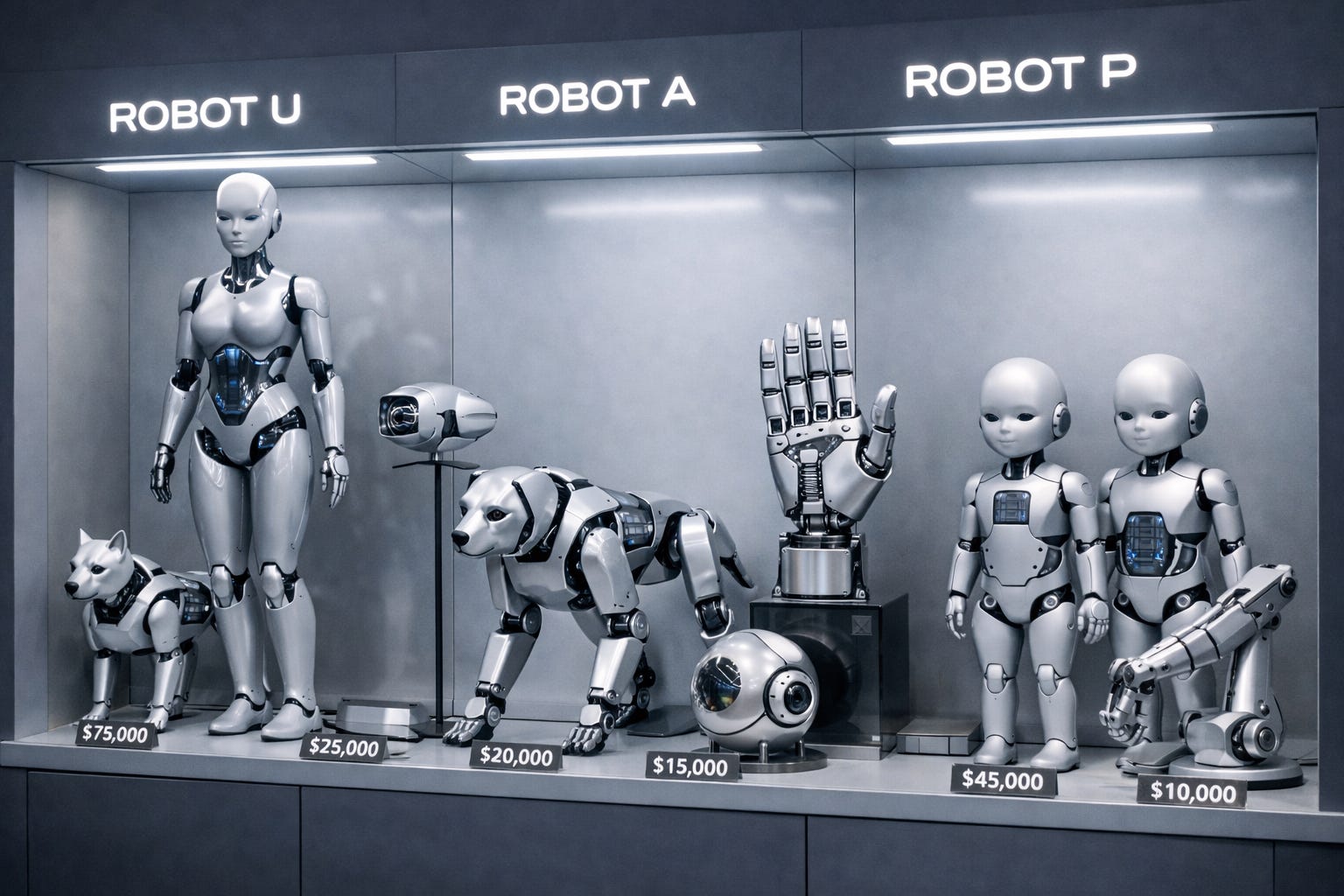
How to Choose a Robot
Let’s take a look at some of the key criteria to consider when surveying the robotics landscape: the factors that help determine whether a robot is truly ready for real-world deployment, or just an impressive demo. To make sense of this, it helps to evaluate robots across a few key questions: how well they understand their environment, how they move, whether they can operate reliably over time, and whether they are already being used in real-world settings.
Embodied Intelligence
The first test of any robot is intelligence: does it understand its surroundings, respond appropriately, and adapt in variable conditions in the environment it is meant for?
The emergence of AI has marked a shift in robotics. Embodied AI combines intelligence with physical structure—the robot’s body, sensors and surroundings—so that it can perceive, decide, and act in the real world.
Rather than solely relying on fixed data, these systems are also trained extensively in simulated environments. This allows robots to learn faster and at scale, while continued learning from real-world deployment improves how well they adapt to changing conditions and handle tasks that require both precision and coordination.
Platforms such as AgiBot’s Real-World Reinforcement Learning (RW-RL) system combine large-scale pre-collected data with on-site training. It allows their robots to learn tasks directly on the factory floor within minutes and adapt to changing production conditions without major reconfiguration, marking a step toward intelligence that improves through real-world use rather than solely relying on fixed instructions.
This shift is not limited to a single company. Other leading full-stack robotics players are also moving in the same direction, overcoming one of robotics’ biggest constraints: the difficulty of collecting enough data to train systems effectively.
By combining simulation and real-world learning, they reduce reliance on slow and costly data collection while improving how quickly robots can be deployed and adapted in practice.
Progress in robotics is increasingly defined not just by hardware performance, but by how well systems can operate in semi-structured or unstructured environments, where situations can be unpredictable, tasks vary, and decisions must be made in real-time.
In other words, look for a robot meant for messy reality, one that can handle unpredictable human behavior, adapt to dynamic settings, recover safely from errors, and improve continuously through experience.
Mobility
Once a robot can decide what to do, the next question is whether it can physically do it.
Mobility is more than whether a robot can walk. It includes balance, payload capacity, movement speed, joint coordination, and how well the machine handles obstacles such as slopes, stairs, tight corners, or uneven ground.
Recent demonstrations, such as Unitree’s G1 humanoid performing complex martial arts movements offer a useful way to interpret these capabilities. While such demos may appear theatrical, they reveal underlying attributes that matter in real-world use, including dynamic balance, precise coordination across multiple joints and the ability to maintain stability while executing fast, continuous movements.
These capabilities are reflected in the robot’s design. The G1 has 43 degrees of freedom, allowing for fine-grained control across its body, while its high joint torque enables it to generate and withstand force during movement.
Its dexterous hands also matter because mobility is not only about locomotion, but about whether the robot has the flexibility and control to manipulate objects and carry out specific tasks. Hand design, force control and degrees of freedom help indicate how precisely it can grasp, hold, and handle objects once in position.
Details like these offer useful clues about whether the robot is meant to fit into specific environments. When evaluating mobility, ask whether the robot’s movement capabilities actually match the physical conditions of the job.
Operational Readiness
A capable robot still needs to operate as part of a real-world system.
Operational readiness is about whether the robot can run consistently within the constraints of your workflow. This includes practical factors such as battery life, charging time, uptime, maintenance requirements, availability of spare parts and support and how the robot handles failures or interruptions.
A robot that performs well in controlled settings but cannot be supported or maintained efficiently may not yet be ready for real deployment. For instance, a robot that operates for two hours but requires four hours to recharge may struggle to sustain continuous operations without additional units or human intervention.
Though often overlooked, this factor ensures whether a robot is practical or just impressive. UBTECH’s Walker S2, for example, is designed to swap its own battery pack and continue operating with minimal downtime.
When evaluating operational readiness, consider whether the robot can run consistently, be maintained efficiently, and operate as part of a larger system.
Real-World Adoption
Even the most advanced robot means little if it hasn’t proven itself outside the lab. It’s important to look at whether the robots being evaluated are already deployed in real environments, who their customers are, and whether those use cases resemble your own needs.
Service robots are already operating in everyday settings. Companies such as Pudu Robotics have deployed robots across restaurants, retail stores, hotels and healthcare facilities worldwide. These robots assist diners in places from Canada and Hong Kong to Malaysia, while others operate in shopping malls across Poland, Thailand and Jordan.
UBTECH has also announced plans to scale production from hundreds to several thousand units over the next few years with automotive manufacturers such as BYD, Geely Auto, FAW-Volkswagen, and Dongfeng Liuzhou Motor beginning to integrate its robots into industrial operations for round-the-clock use.
These figures indicate how quickly robots are moving from experimental prototypes toward commercial deployment. Look for signs of real-world traction: how many units have been shipped, whether production is scaling up, and whether the robots are being used by real organisations.
Where This Leaves Us
Robots are useful because they can take on routine tasks with consistency and minimal supervision. With companies ramping up production and preparing for wider deployment, robots are beginning to show up across a growing number of settings, from service environments to industrial operations: in different forms, for different kinds of work.
So if you are considering a robot, don’t forget to ask a few fundamental questions:
Can it move reliably in your environment?
Can it understand and respond to what’s happening around it?
Can it operate consistently within your workflow over time?
Is it already being used outside the lab?
The best robot is not the most futuristic one; it is the one whose capabilities match the job you need done.
Acknowledgements: Thank you to the Sunway iLabs team for their invaluable contribution and insights in preparing this article.
References
FutureX Insights. (2026). Robots Among Us. Futurexinsights.news. https://www.futurexinsights.news/p/robots-among-us?r=6i8ih6&utm_campaign=post&utm_medium=web
Jijo Malayil. (2025, December 30). UBTECH robot dances, kicks box as 1,000 Walker S2 milestone marked. Interesting Engineering. https://interestingengineering.com/ai-robotics/china-ubtech-builds-1000-humanoid-robots
South China Morning Post. (2025, November 19). South China Morning Post. https://www.scmp.com/tech/article/3333427/ubtechs-2026-humanoid-robot-output-grow-10-fold-costs-plunge-scale-economics