

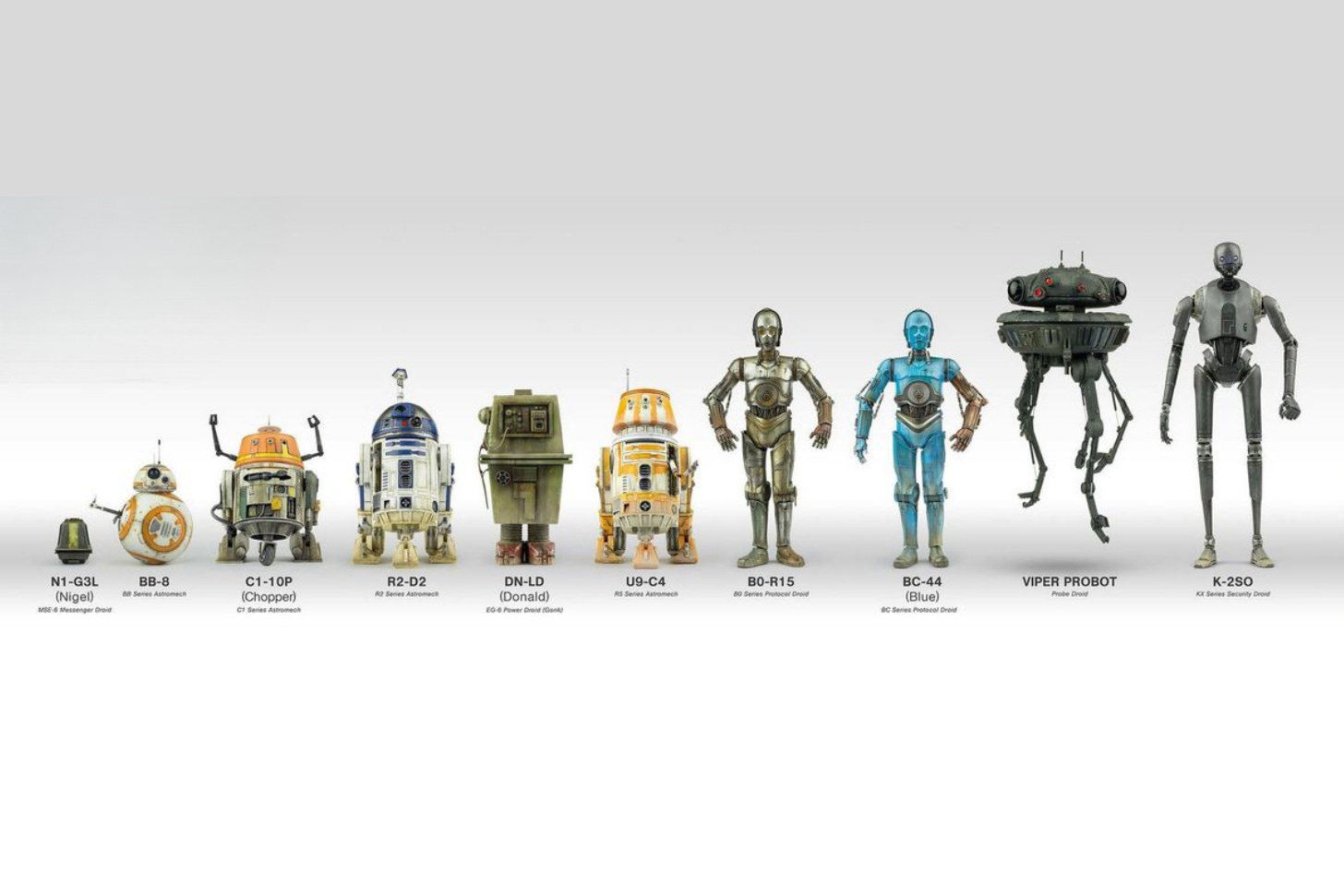
In Star Wars robots weren’t special…they were useful.
Long before real-world robots showed up, sci-fi imagined a world where robots handled everyday work.
The arrival of robot vacuum cleaners in the early 2000s marked the dawn of service robotics. Designed to operate autonomously, they quickly gained traction in busy households, with early models like the Roomba selling over a million units within two years.
This opened up new possibilities for automation: service robots handling routine tasks around the clock without needing constant supervision.
Broadly speaking, this is what service robots are designed for, to work in everyday environments, helping organisations deal with labour shortages and long, repetitive tasks that humans would rather not do themselves, without getting tired.
They aren’t robots confined to factories or dealing with manufacturing products, but instead they are there to support daily tasks such as in hotels, hospitals, malls, airports and offices.
Beyond the Gimmick
For a long time, robots moved through the world by following fixed paths. They knew where to go, but not much about what they were looking at.
That has started to change.
Today’s robots often appear in demos, videos, and public showcases — from making appearances at shopping malls like Sunway Pyramid and i-City to dancing on shows like America’s Got Talent — capturing attention and showing what robots can do in motion.
With recent advances in AI, robots are increasingly able to make sense of spaces rather than just move through them. By combining vision, language, action (VLA) and large language model (LLM), today’s robots can interpret their surroundings and adjust how they move or work in real time.
You may already be familiar with some humanoid robots like Agibot, and robot dogs such as Unitree’s Go2 and Boston Dynamics’ Spot.
Still, robots aren’t just built to impress people, they’re there to do real work.
What These Robots Are Really Used For
Service robots have been taking on more practical roles from robot vacuums like iRobot’s Roomba cleaning floors at home to cat-eared waiter robots like Pudu Robotics’ BellaBot delivering your plate of roti canai at mamak restaurants.
So who else is already putting robots to work?
The Trouble with Keeping Things Clean
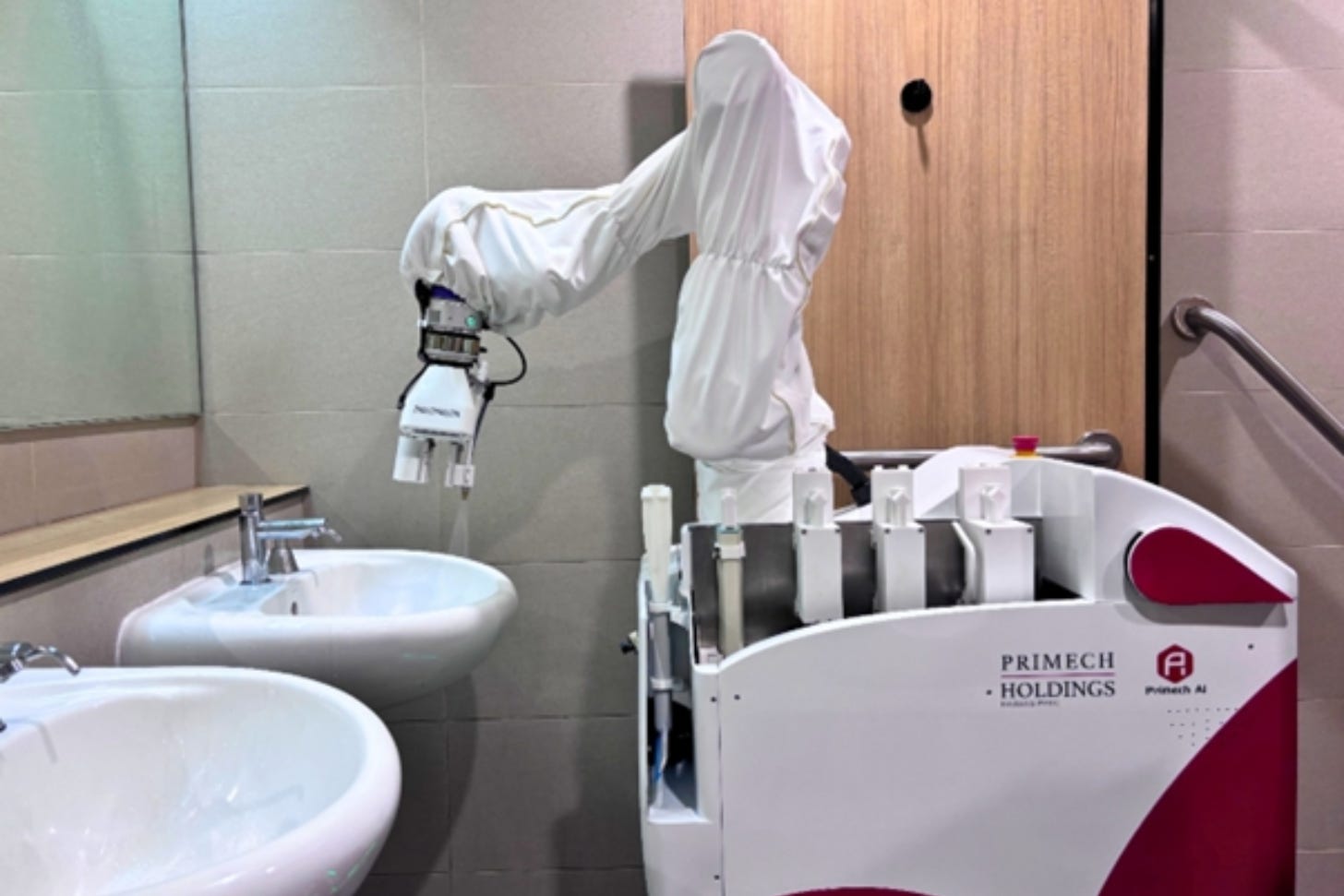
Cleaning is more complicated than it looks.
Primech AI’s Hytron robot is built for this exact challenge. It is designed to operate in tight, wet environments like restrooms, where automation is particularly difficult.
It can scrub floors, clean toilet bowls, and sanitise surfaces while navigating large facilities. This makes Hytron suitable for places where hygiene standards are high and cleaning needs to be consistent.
Hytron robots are already deployed in some of Singapore’s prominent public hospitals and shopping malls, and large facilities in parts of Asia and Europe, where cleanliness is non-negotiable.
Some other cleaning robots like Pudu Robotics’ CC1 and SoftBank Robotics’ Whiz are also designed for routine cleaning in commercial spaces.
The Trouble with Getting Things Delivered
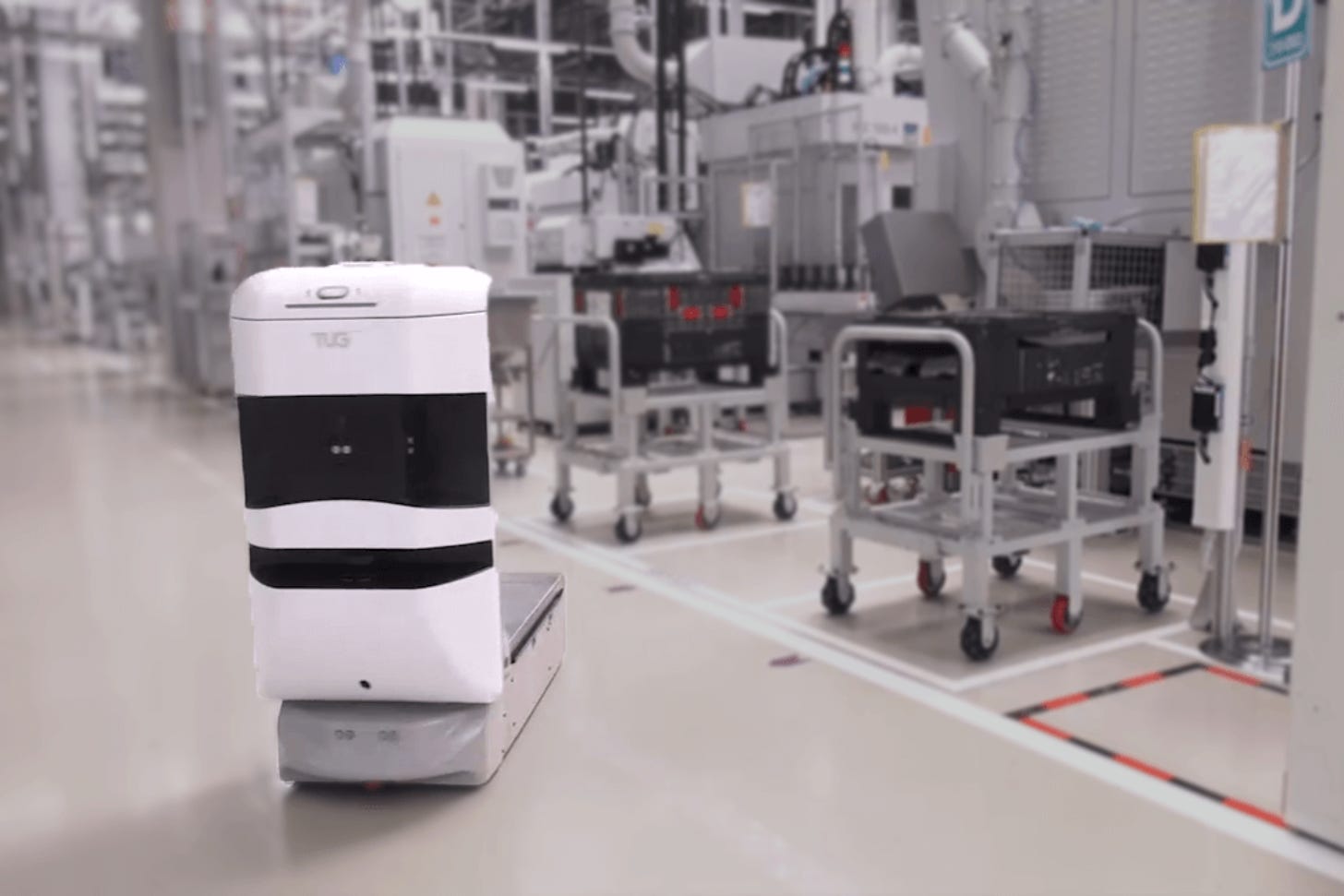
In a hospital, things are constantly on the move.
Medications travel from pharmacies to wards, and meals, linens and lab supplies move between floors all day long.
Aethon’s robots such as the T3 and Zena RX can transport medical supplies securely, along scheduled routes across hospital floors, operating continuously throughout the day. By doing so, these robots can reduce the time nurses and staff spend moving items and free them to focus more on patient care. Relay and Ottonomy’s delivery robots also explore how supplies can be delivered with care across hospitals, hotels and other large facilities.
Aethon’s robots are already in use across major hospitals in the U.S and Singapore, including the largest fleet of over 90 robots deployed at Children’s Healthcare of Atlanta.
The Trouble with Parking
Parking is one of those problems that most people just put up with.
In dense cities, space can be limited, ramps are tight, and a lot of room is wasted just to accommodate human driving and door-opening.
Shenzhen Shanyi Technologies tackles this problem by removing the human driver from the parking process entirely. Their robots lift and move cars within dense parking facilities, slotting them into spaces that would usually be difficult, sometimes even impossible, to navigate manually. With its automated parking robot, cars can be parked faster and closer together.
Shenzhen Shanyi Technologies automated parking robots have moved beyond pilot trials into production, with systems adopted in commercial facilities in China, including large parking complexes, transport hubs and industrial sites.
Other automated parking systems like Parkie also focus on increasing space efficiency and reducing the hassle of parking.
Where This Leaves Us
By now you can probably picture the kinds of work robots are already taking on. Service robots aren’t meant to be shiny centerpieces, they’re built to do the work. There are many more service robots already operating and still being developed.
As technology matures and challenges around safety and deployment are worked through, we may find ourselves closer to the world of sci-fi…much like Star Wars, where robots live among us as helpers woven into everyday life.
Coming Up Next
Up next, we’ll zoom in to look at the robot value chain and how AI is reshaping robotics, from the brain that makes decisions to the body that carries them out.
Acknowledgements: Thank you to the Sunway iLabs team for their invaluable contribution and insights in preparing this article.
References:
International Federation of Robotics (IFR). (2025). Service Robots See Global Growth Boom. IFR International Federation of Robotics. https://ifr.org/ifr-press-releases/news/service-robots-see-global-growth-boom
Primech AI. (2025, June 12). The Real-World Use Cases of Robotics in Commercial Cleaning - Primech AI. https://primech.ai/the-real-world-use-cases-of-robotics-in-commercial-cleaning/
Robots Authority. (2024). The History of the Roomba: The First Commercially Successful Robot Vacuum. Your Guide AI and Robotics. https://robotsauthority.com/the-history-of-the-roomba-the-first-commercially-successful-robot-vacuum/
Shanyi Technologies(深圳閃移技術有限責任公司)৹ 最先端レーザー、ロボット、計測技術のカンタム・ウシカタ. (2024). Kantum.co.jp. https://www.kantum.co.jp/manufacturer/Shanyi
ST Engineering. (2025). Stengg.com. https://www.stengg.com/en/innovation/innovation-stories/transforming-hospital-operations-with-autonomous-mobile-robots/