
A few weeks ago, over coffee in Cambridge, a founder said something half-joking, half-serious:
“We’re building as fast as we can… before OpenAI builds it in a weekend.”
Everyone laughed. No one disagreed.
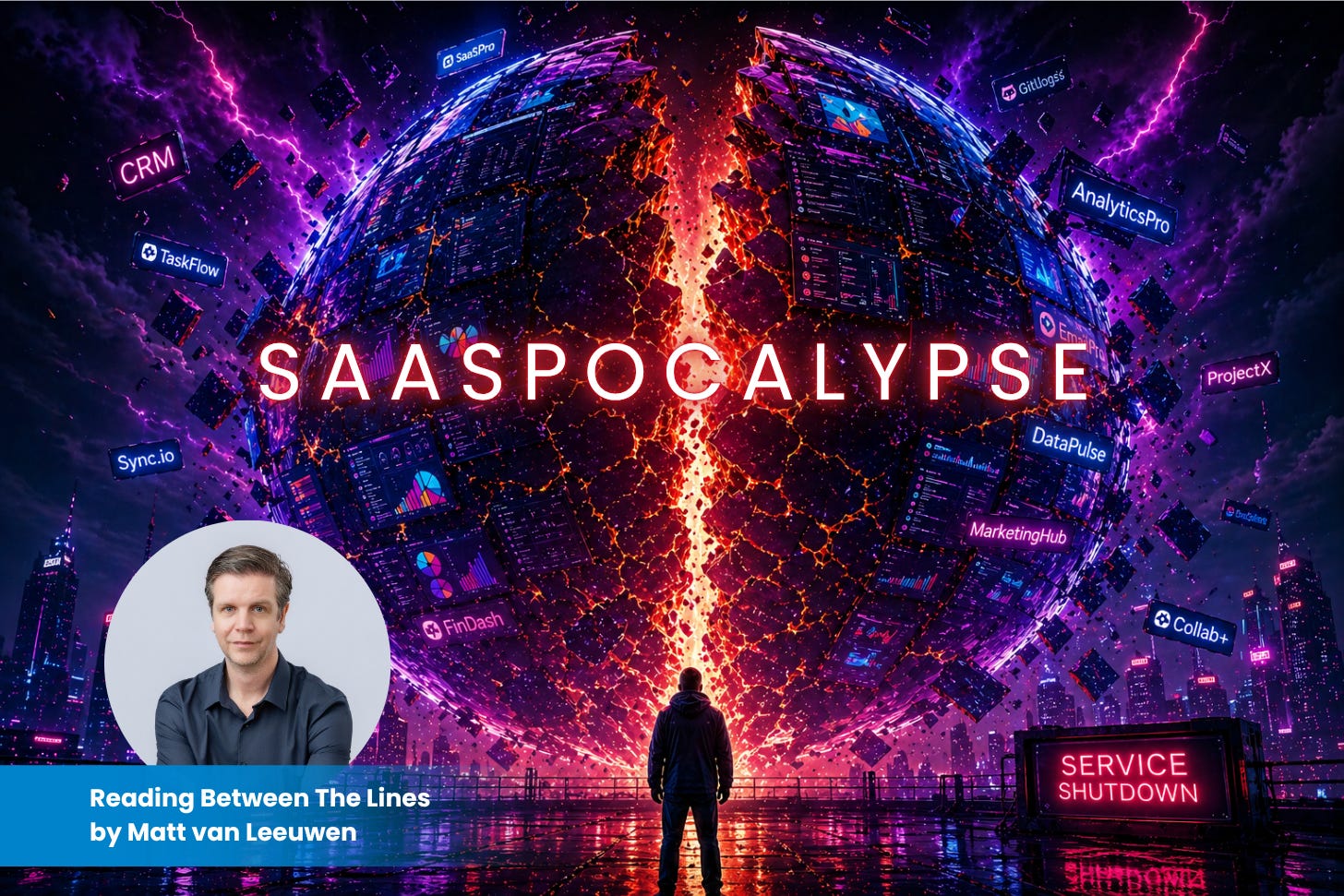
A few days later, a partner at a16z sent me two articles on what people are now calling the SaaSpocalypse: “Good News: AI Will Eat Application Software” and “Death of Software? Nah.” Both are a great read.
They didn’t give me an answer though. But they did sharpen the question.
Is SaaS actually under threat? Or are we misunderstanding what’s changing?
The shift is subtle, but important
For years, SaaS followed a simple model. You built software that helped people do their work, and you charged them per seat. More users meant more revenue.
AI starts to change that relationship.
Software is no longer just helping with the work. It is beginning to do parts of the work itself.
AI agents can autonomously perform complex tasks, diminishing the need for multiple specialized SaaS applications.
That sounds obvious, but it changes how value is perceived. If the outcome becomes easier to deliver, the product itself becomes easier to question.
A simple example: legal tech
Take legal software.
Traditional SaaS companies have built tools to help lawyers manage documents, collaborate, and track workflows. These tools improve efficiency, but the work still sits with the lawyer.
Now look at Harvey AI.
Harvey doesn’t just organise work. It can draft documents, review contracts, and support legal reasoning. The focus shifts from managing the process to shaping the outcome.
With AI, software is moving from being a tool to becoming a worker.
That difference starts to matter commercially. One model charges for access. The other is much closer to charging for results.
What is actually changing
This is where much of the SaaSpocalypse discussion comes from.
Pricing is the first pressure point. If fewer people are needed to do the same work, per-seat pricing becomes harder to defend. Buyers begin to ask what they are actually getting, not just how many licences they need.
At the same time, it has become much easier to build and replicate features. What used to feel differentiated can now be recreated quickly. This creates the impression that software is becoming commoditised.
But that is only part of the picture.
What is not changing
Software companies were never valuable just because of their code.
They became valuable because they sat inside important workflows, accumulated data over time, and built trust with their users. Those things are still hard to replicate.
If anything, AI makes them more important.
This is why many incumbents are not disappearing overnight. And it is also why new entrants succeed when they go deep into a specific workflow, rather than building something generic.
A clearer way to think about it
The term SaaSpocalypse suggests an ending.
What is actually happening feels more like a shift.
We are moving from software that supports work to software that participates in it. That changes how products are built, how they are priced, and where defensibility comes from.
For founders, the implication is quite practical.
SaaS companies need to rethink how they deliver value, not just add AI features on top. AI startups need to go beyond demos and build systems that customers genuinely rely on.
This is not just a race to adopt AI, but to rebuild around it and redefine where the moat lives.
That shift is already showing up in the traditional SaaS pricing model, with many in the industry pointing to a move away from per-seat licensing toward consumption-based approaches, closer to prepaid tokens than fixed licences.
So, is the SaaSpocalypse real?
In some ways, yes.
Some pricing models will struggle. Some products will lose their edge. Certain categories may shrink.
But software itself is not going away.
It is moving closer to the outcome.
Back in Cambridge, after the initial joke, the founder paused and added:
“The real risk isn’t that OpenAI build what we build. It’s that they solve the problem before we do.”
That feels like the right lens.
The question is no longer who builds the best software.
It is who gets closest to solving the problem that actually matters.