

Artificial intelligence (AI) is fuelling a new wave of excitement and anxiety across venture capital markets.
At FutureX Venture Fest 2026, organised by Sunway iLabs on the 12 May 2026, one statistic captured the mood perfectly. AI company Anthropic reportedly climbed from a valuation of around US$60 billion in early 2025 to approximately US$380 billion by 2026, one of the clearest signals that the AI race has triggered a modern-day gold rush in venture capital.
But beneath the excitement sits an older fear familiar to every experienced investor:
What happens when markets start moving faster than anyone can predict?
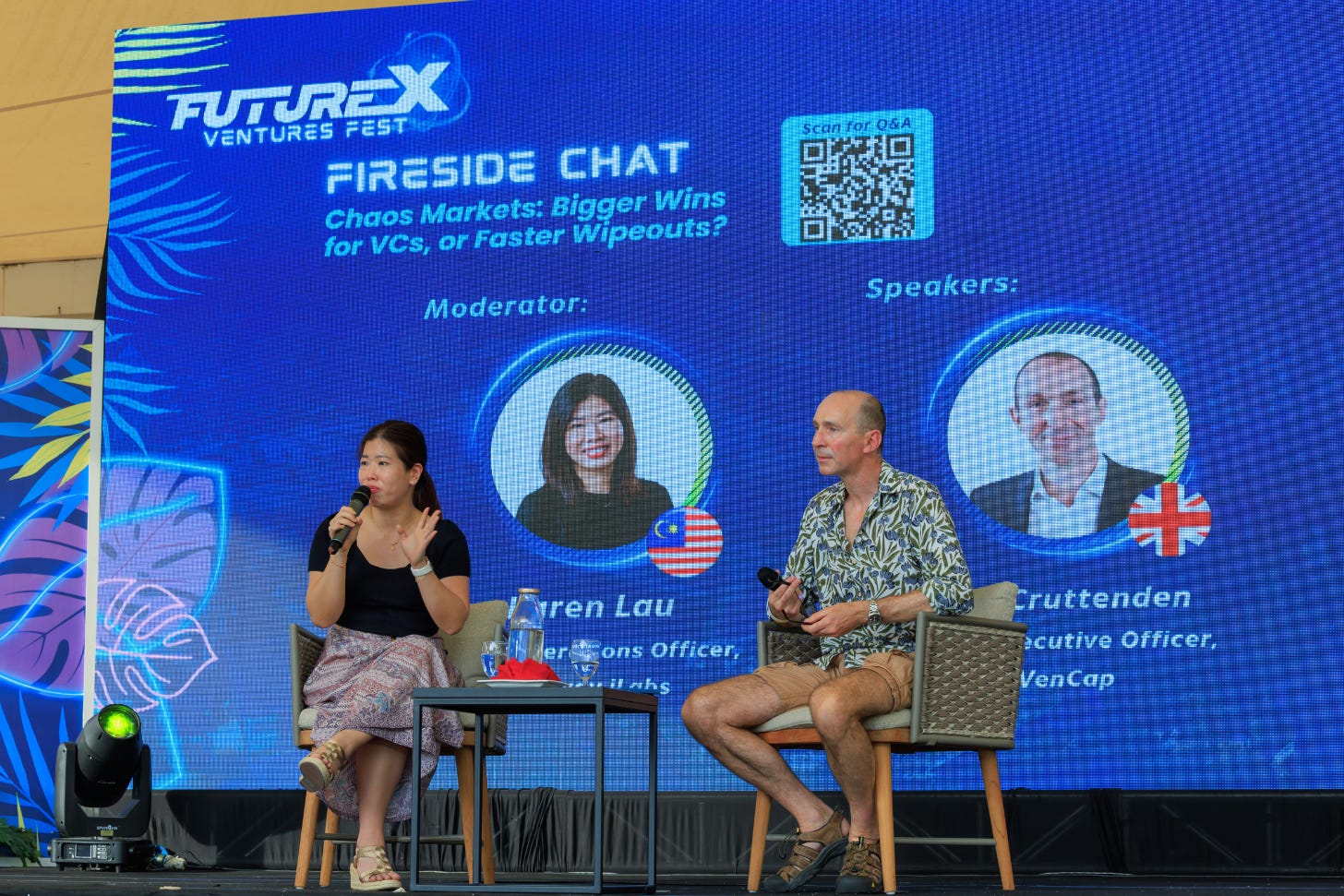
Those tensions sat at the centre of the fireside chat, “Chaos Markets: Bigger Wins for VCs, or Faster Wipeouts?,” featuring Tim Cruttenden, Chief Executive Officer of VenCap, moderated by Karen Lau, Chief Operations Officer of Sunway iLabs.
Lau described how investors are increasingly caught between FOMO (fear of missing out) and a distinctly Malaysian sense of kiasu: the fear of losing out while everyone else races ahead.
VenCap, a UK-based venture capital investment firm has backed leading venture funds across the United States, Europe and Asia for nearly four decades. For Cruttenden, who has invested through the dot-com crash, the financial crisis and now the AI boom, today’s market feels less like a normal technology cycle and more like a structural shift in human progress itself.
He described AI as an “absolute dislocation” comparable to the invention of steel.
And unlike previous technology waves, many of the companies shaping AI like OpenAI, Anthropic, Mistral, Cursor, Databricks and SpaceX are still private, placing venture capital firms at the centre of the transformation.
Yet one idea surfaced repeatedly throughout the session:
In chaotic markets, survival belongs less to whoever moves fastest, and more to whoever stays disciplined longest.
Betting Through Uncertainty
The challenge with AI is that nobody truly knows where the biggest long-term winners will emerge.
That uncertainty shapes how experienced investors think.
Cruttenden argued that the best venture investors are often less focused on predicting technologies themselves, and more focused on identifying the people who consistently spot transformative companies early.
For firms like VenCap, that has meant backing a concentrated group of venture funds with strong track records across US, Europe and Asia; a strategy that provided early exposure to companies such as Google, Meta, ByteDance, Databricks, OpenAI and Anthropic.
That philosophy is rooted in what investors call the power law: where a tiny number of companies generate the overwhelming majority of returns.
According to Cruttenden, roughly 1% of venture-backed exits create half the value across the entire market. The difficulty is that nobody can consistently predict where those outliers will emerge, especially during moments of technological mania.
Which is why many experienced investors avoid overcommitting to a single dominant model or platform too early. Instead, the strategy increasingly resembles a diversified “basket approach” across infrastructure, developer tools, applications and AI agents.
Cruttenden repeatedly returned to lessons from the dot-com crash, when investors chased growth aggressively before the market eventually collapsed.
The goal, he argued, is not to avoid risk.
Venture capital depends on risk-taking.
The objective instead is to avoid becoming trapped when excitement begins outrunning reality.
In chaotic markets, diversification is not hesitation.
It is survival.
No Shortcuts for Southeast Asia
The conversation eventually turned toward Southeast Asia’s ambition to build globally competitive technology ecosystems.
Silicon Valley’s advantage was never built on capital alone. It emerged over decades through a combination of entrepreneurial culture, supportive regulation, institutional funding and repeated startup successes that created a self-reinforcing flywheel.
That kind of ecosystem takes time to develop.
The discussion also pushed back against one of the most common assumptions across emerging markets, that the main problem is a lack of growth capital. More often than not, the challenge is building enough companies capable of scaling into truly world-class businesses.
In the end, strong ecosystems are not created overnight through funding alone. They are built gradually through supportive systems, risk-taking culture and founders capable of creating the next generation of breakout companies.
Acknowledgements
Special thanks to Tim Cruttenden, Chief Executive Officer of VenCap, and Karen Lau, Chief Operations Officer of Sunway iLabs, for their thoughtful insights and contributions during the fireside chat at FutureX Venture Fest 2026.