

I I still remember spending evenings working with Adobe Premiere Pro and Final Cut Pro, manually cutting footage, adjusting transitions and typing captions line by line for long-form videos. A full-length production for a one-minute video took at least one month, from pre-production to post-production.
Then came Canva & CapCut.
Templates, auto-captions and simpler editing workflows dramatically lowered the barrier to creating content. Technical execution became easier, allowing marketers to spend less time wrestling with software and more time thinking about the story they wanted to tell.
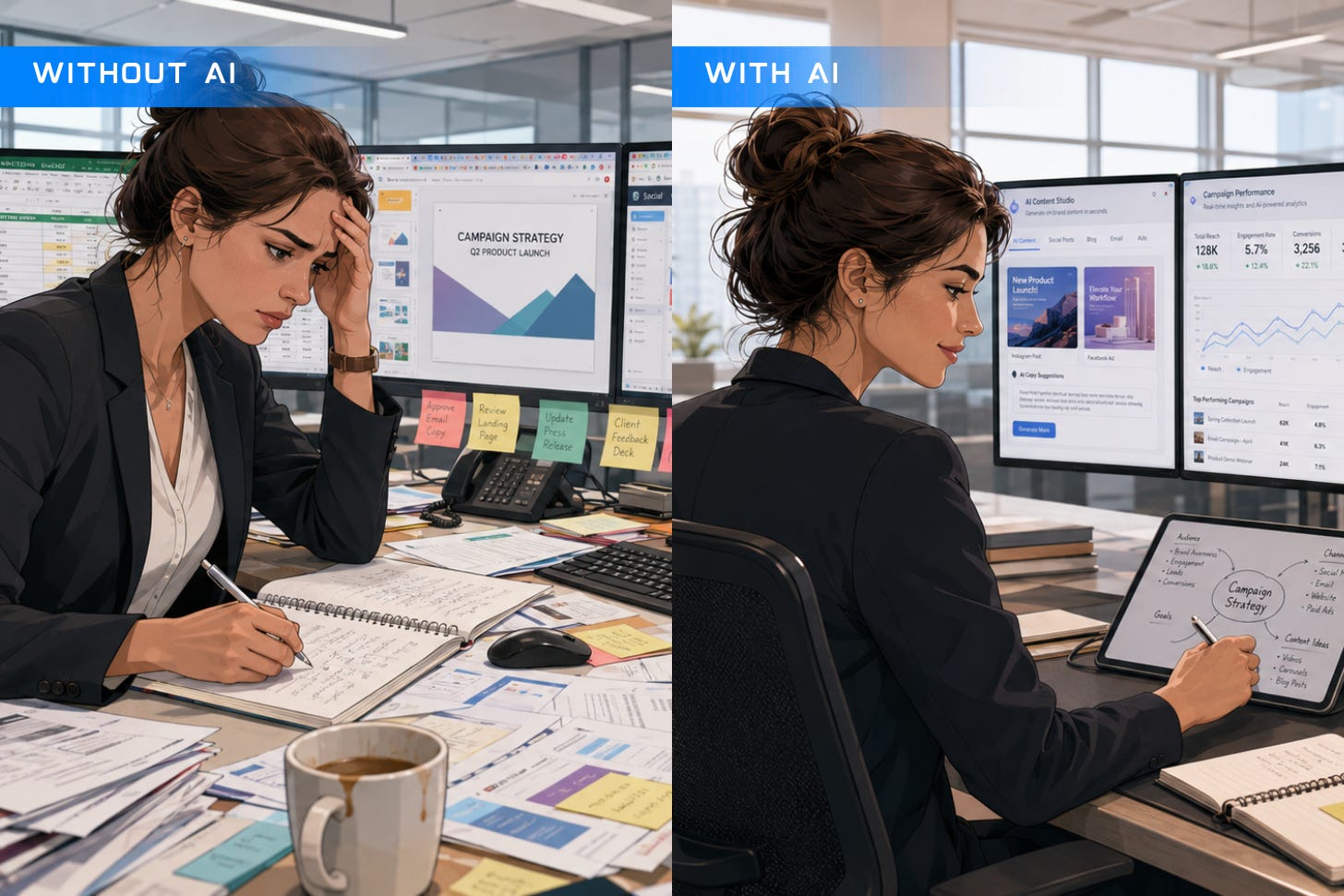
Not long after came the era of GenAI such as ChatGPT and Gemini. Instead of staring at a blank page, marketers could brainstorm campaign concepts, draft scripts, generate visuals and explore creative directions within minutes.
Most people would describe this as a story about speed: every new tool removed a bottleneck, allowing marketers to work faster, improve their productivity, and now they have more time to think.
But that's only part of the story.
If you look closely at where AI is going, the bigger shift isn't that marketers can work faster. It’s that more of the work, and the customer relationship along with it, is quietly moving into environments that marketers don’t fully control.
If creating content is becoming easier, where does marketing create value next?
L’Oréal’s AI-powered beauty content platform, CreAItech, brings together models from Google, Adobe, NVIDIA, Seedance, and OMI to assist the company’s global marketing teams in producing creative assets at scale.
The payoff? A 40% drop in production costs and the creation of more than 50,000 marketing assets.
At first glance, it looks like another productivity story.
Read it again:
Cheaper to make. 50,000 of them.
That isn’t just efficiency; it’s a flood.
The unsettling possibility is that near-free content doesn’t win attention; it devalues it. We may end up in a world where more of us are shouting, more cheaply, at people who aren’t listening.
Are your customers still yours?
L’Oréal’s recent partnership with OpenAI shows where this is heading. Customers can also discover products, get personalised advice, and even virtually try on makeup, all within ChatGPT. Basically, like having your very own AI beauty assistant.
As that happens, Search Engine Optimisation (SEO) is gradually making room for Generative Engine Optimisation (GEO) and Answer Engine Optimisation (AEO), where brands increasingly optimise their information to be accurately surfaced by AI assistants rather than traditional search engines. In other words, the battleground for visibility is beginning to shift.
AI may change how marketing is executed, but it doesn’t change what makes marketing effective. The goal remains the same: earning attention, staying relevant and influencing decisions.
For organisations forever chasing the next productivity gain, the harder question isn’t how much faster AI can make you. It is about whether speed is still worth winning.
Are we acting on it?
According to Boston Consulting Group’s (BCG) 2026 global survey, almost every CMO believes AI is transforming marketing. Yet around 42% are still using AI mainly as an assistant for isolated tasks. Only about a third have started redesigning their workflows, and just 8% are already running autonomous, multi-agent campaigns.
The easy read is that 92% of the marketers just aren’t ambitious enough.
Perhaps we’re no longer limited by what AI can do, but by what we’re asking it to do.
Moving beyond isolated AI tasks requires organisations to rethink how they choose technology. Rather than automating marketing one task at a time, McKinsey suggests building the workflow by breaking it down into core capabilities: from generating content and analysing data to planning campaigns, localising content and operations, before deciding where AI agents can create the most value.
As more of the technical execution moves to AI, marketers gain something far more valuable than speed: time.
Time to understand customers better, earn attention, stay relevant and ultimately improve conversion.
Naturally, this also changes the marketer’s focus.
Marketers will spend less time producing each deliverable and more time designing how the work should be done. They define the objectives, set the guardrails, shape the brand, decide which stories are worth telling and determine where human judgement still matters.
What’s left for the marketers
Every major shift in marketing technology has done more than make work faster. It has changed what marketers spend their time doing.
When search engines emerged, we learned SEO. When social media arrived, we learned engagement. When generative AI appeared, we accelerated content creation.
If content is nearly free, what are we competing on?
If the AI assistant owns the customer, what do we own?
And if AI eventually becomes capable of curating and executing strategy, is our role defined by AI in terms of what we can do?
Perhaps, the future marketers won’t be measured by the number of campaigns launched or assets produced. Those may become commodities.
The enduring advantages have never been the tool. It has always been the ability to understand people, what they value and what they trust, and why they choose your brand over another. That is what turns attention into loyalty, and loyalty into revenue.
Perhaps the real competitive advantage isn’t having better AI; it’s about how we leverage AI. The tools never defined the best marketers, but their wisdom and mindset.
Marketers are defined by how well they understand people.
When everyone has access to the same AI, the real differentiator won’t be the technology. It will be the quality of human thinking behind it
Acknowledgements: Thank you to the Sunway iLabs team for their invaluable contribution and insights in preparing this article.
References
Abraham, M., Wiener, L., Palumbo, S., Apotheker, J., Bajaj, P., Balis, J., Arnoldsen, A., & Dewey, P. (2026). Moving the Agentic Marketing Transformation from Illusion to Reality. BCG Global.
Bradley, S. (2026). L’Oréal accelerates generative AI content engine with fresh OpenAI deal. Digiday.
Esber, D., Stein, E., Boudet, J., & Robinson, K. (2026). Reinventing marketing workflows with agentic AI. McKinsey & Company.
L’Oréal. (2021). Catherine Ngila: For a more Sustainable Water Management. L’Oréal.
Wiener, L., Beaulieu, F., Kropp, M., Kelman, L., Iny, A., & Ho, V. (2026). Agentic Scenarios Every Marketer Must Prepare For. BCG Global.