

Personal AI assistants like OpenClaw are quickly evolving beyond what once felt like “toy-like” experiments into tools capable of cross-referencing emails, meetings, and personal writing, functioning almost like personalised operating tool for work and life.
That shift in perspective captured the broader theme of the fireside chat session,
“AI in 2026: The Breakthroughs Nobody Predicted… and the Ones We Still Don’t See Coming.,” held during FutureX Ventures Fest 2026, organised by Sunway iLabs on the 12 May 2026.
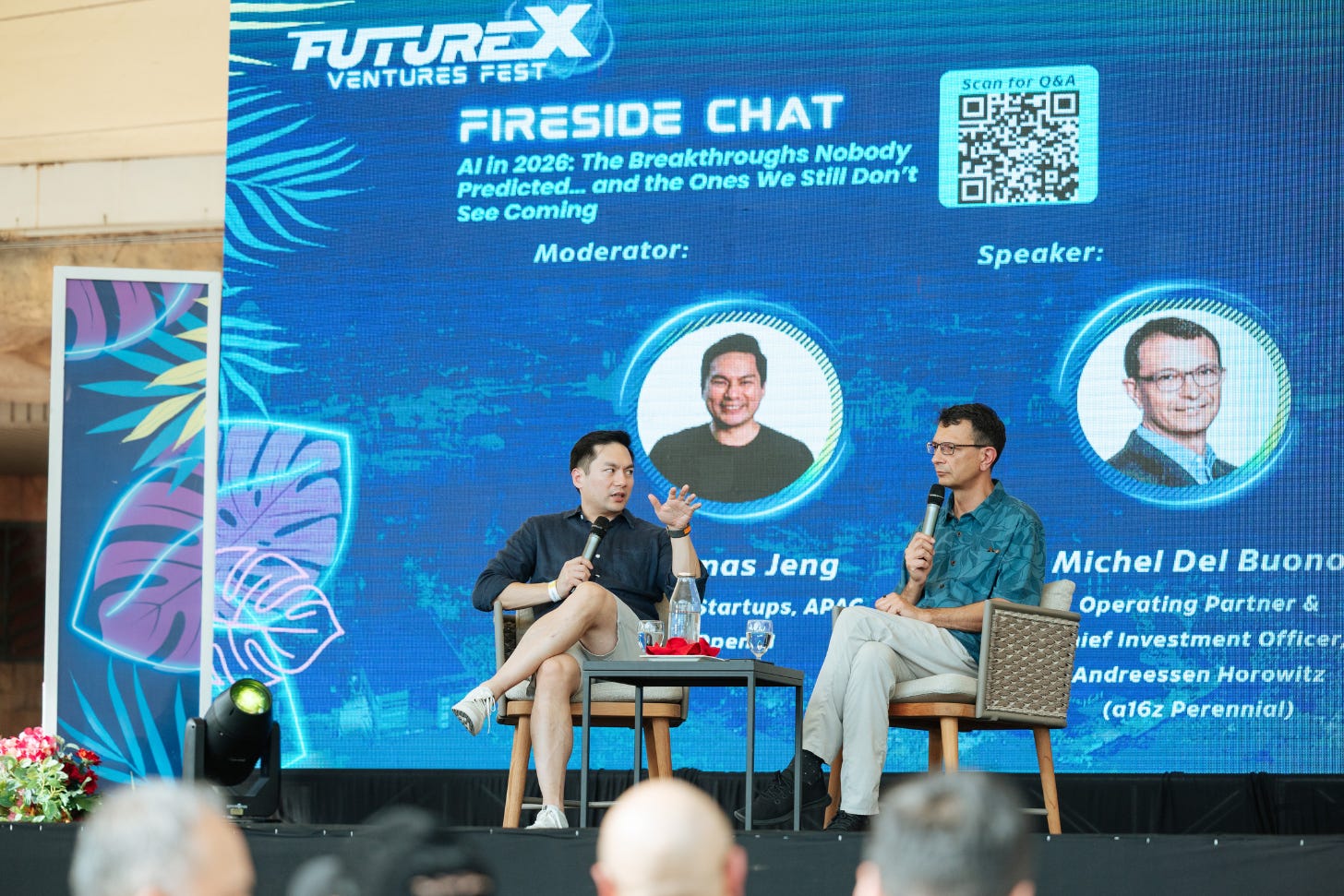
Moderated by Thomas Jeng, Head of Startups, APAC of OpenAI and featuring Michel Del Buono, the Operating Partner & Chief Investment Officer of Andreessen Horowitz (a16z Perennial), the two discussed about what happens when AI fundamentally changes the economics of building, scaling, and competing.
Underneath nearly every point raised during the session was one core idea:
Software is becoming dramatically cheaper to create.
The Collapse of Software Costs
The most important shift discussed during the session was not AI itself, but what AI is doing to the economics of building software.
According to Del Buono, some teams have become as much as 20 times more productive in just the last six months. Tasks that previously required entire engineering teams can now be handled by a few people using AI coding agents and automated workflows.
That productivity jump is beginning to reshape the financial assumptions of the startup ecosystem from the ground up.
One concept that emerged from the discussion was what Del Buono described as “disposable software.” Instead of building permanent applications, developers are increasingly creating software for highly specific use cases, deploying it quickly, and abandoning it once the task is complete.
He shared an example involving his son, who built a tool that scanned academic papers across universities, generated personalised outreach emails to professors, tracked responses, and automated parts of the internship application process. The software served its purpose once and was never needed again.
Software, in other words, is starting to behave more like a temporary workflow.
And once software becomes cheap to create, the effects begin cascading outward.
The Rise of the Lean Titan
One downstream effect is the emergence of what could be described as the “lean titan”: highly efficient startups operating with minimal overhead.
The AI startup ecosystem is increasingly splitting into two extremes.
On one side are infrastructure giants raising enormous amounts of capital to build foundational models, compute infrastructure, and tooling layers. On the other are tiny AI-native teams building profitable businesses without needing much funding at all.
More founders are choosing to stay bootstrapped for longer periods of time. With AI dramatically reducing development costs, some are reaching multi-million-dollar revenue run rates while maintaining tiny teams and retaining full ownership control.
For ecosystems outside Silicon Valley, this shift could prove significant.
Historically, access to deep capital markets gave certain regions a structural advantage in building globally competitive software companies. But if AI continues reducing the cost of execution, talented founders in Southeast Asia and beyond may no longer need Silicon Valley-scale funding to compete internationally.
The economics of ambition begin to change.
The New Moat Is Judgement
As software creation becomes increasingly commoditised, another question naturally follows:
What actually becomes defensible?
The answer, increasingly, is not the code itself.
It is judgment.
During the discussion, both speakers pointed toward a future where the strongest companies are the ones best able to orchestrate multiple models together depending on the task: optimising for reasoning quality, latency, workflow performance, or cost efficiency.
But the deeper advantage lies in knowing what to optimise for in the first place.
AI can generate the first 80% remarkably quickly. But the final layer — knowing what matters, what feels right, what to optimise for, and how to refine the output — still depends heavily on human expertise.
In an environment where software becomes abundant, taste starts becoming infrastructure.
When Historic Valuation Models Break
The conversation eventually moved beyond startups and into a more difficult question for investors and policymakers alike:
How do you value the future when historical comparisons stop working?
Jeng noted that traditional economic frameworks are generally built around first-order effects: relatively predictable outcomes that emerge from gradual change. That logic works reasonably well when industries evolve incrementally.
AI may not.
Building on that point, Del Buono used autonomous driving to explain how transformative technologies create second- and third-order effects that are difficult to predict ahead of time.
The first-order effect is obvious: self-driving cars make transportation more efficient.
But the bigger changes come after that.
If people can sleep or work while commuting, they may become more willing to live two or three hours outside city centres. Over time, that could reshape urban planning, property values, transportation systems, and even insurance markets if accidents become less common.
In other words, the technology doesn’t just improve driving. It changes human behaviour, and that creates ripple effects across entire industries.
For investors, that makes valuation unusually difficult.
Traditional investment models rely heavily on historical comparisons. But with AI, many of the biggest economic effects may only emerge later through cascading second- and third-order consequences that are still impossible to fully measure today.
Time to Start Tinkering
The conversation also touched briefly on regulation, where Del Buono compared AI to the spread of the printing press centuries ago.
When printing presses were rare, information was easier to control because there were only a handful of people producing it. But as the technology spread and printing became widely accessible, centralised control became far more difficult.
AI may already be entering a similar phase.
Just six to twelve months ago, many assumed advanced AI systems would remain concentrated within a handful of major companies because the technology seemed too expensive and complex for ordinary people to run themselves. Today, open-source models are already being run locally on personal machines.
Once a technology becomes cheap, widespread, and accessible to everyone, controlling it becomes far more difficult.
Open-source models are becoming more powerful and increasingly accessible on personal machines, making the technology harder to centralise or contain. The broader implication was not that regulation no longer matters, but that adaptation may move faster than policy itself.
And that may be why both speakers ultimately arrived at the same conclusion:
The best way to understand AI is to engage with it directly.
Experiment with the tools.
Build things.
Learn by doing.
Acknowledgements
Special thanks to Michel Del Buono, Operating Partner & Chief Investment Officer of Andreessen Horowitz (a16z Perennial), and Thomas Jeng, Head of Startups, APAC at OpenAI, for their thoughtful insights and contributions during the fireside chat at FutureX Ventures Fest 2026.